
Language Exchange Calls
I hope you had a good Easter. I watched a sermon where the pastor preached in French while another man interpreted everything into Arabic. Here’s the video, if you’re curious: https://www.youtube.com/watch?v=ZT_l63hIGzs I understood the sermon in both languages equally well: about 80%, which makes it an ideal comprehensible input video for me. 
Speaking of language learning, here are my previous articles:
How to Learn a Foreign Language – Part 1
How to Learn a Foreign Language – Part 2
How to Learn a Foreign Language – Part 3
How to Learn a Foreign Language – Part 4
Read those first, then return here. Especially part 4, which shows how to find a language practice partner on Conversation Exchange. At the end of that article, I promised we’d cover how to do a call. Let’s do that now. This will be long, but supremely practical. Do what I describe here and you WILL become conversational in your language. You’ll have to, because you’ll be in situations where you have to speak it to a real person (not just to yourself in the mirror).
How to Begin
Your shiny new language partner appears on the call. It’s a Spanish speaker who knows English to an intermediate level. You know that’s true from his smooth introduction that doesn’t rely on any Spanish. When it’s your turn, all the Spanish you’ve ever learned whooshes out through your ears, and English words gather on your tongue like they always have. About now, you might be taking my name in vain for having pressured you into this. 😂 But eventually those introductory phrases you studied ahead of time fly back into your ears, and you blunder through the basics: how you love cats and chocolate and, um, chocolate cats, and so forth.
You struggle to roll your Rs, forget words you knew yesterday, and aren’t sure if your prepared sentences are even correct. None of that matters. This is just practice. Your partner knows you’re a beginner, so don’t pressure yourself. And if your sentences came straight out of Google Translate, they probably need a bit of correction, anyway. Ask your partner to correct the sentences right there on the call. Paste them into the chat for him to review.
When he types out corrected versions of your sentences, copy them from the chat and paste them into your original document, overwriting the old versions. Set aside time to memorize these later. But for now, repeat them aloud and ask your partner for feedback on your pronunciation. When you realize you’re going to need the phrase “can you hear me?” because the internet signal is poor, go ahead and ask him how to say this. Then when you find yourself asking “Can you write that in the chat for me?” in English, ask him how to say that, too. You’ll soon see what phrases you’re actually going to use. Learn those first. Wean yourself off of English.
If you ever feel stressed during these calls:
-You’re probably going too fast. Slow down.
-You’re expecting perfection right now. Let yourself make mistakes. Play with the language.
After the Canned Sentences
Once you’ve exhausted your list of prepared sentences, your partner goes “off-script”, asking questions you don’t have Spanish words for yet. Conversations are animals that sniff their way into unexpected thickets, after all. If you and your partner turn on cameras, and he sees your Zelda poster in the background, he may gush about how much he loves Tears of the Kingdom. You want to say, “I love the new crafting mechanic,” but you can only say part of it. That’s fine. Just say the part you know and leave the rest in English:
“Me encanto el nuevo crafting mechanic.”
Your partner will probably understand this just fine. If not, ask him to wait while you type your sentence into Google Translate. It will spit out this:
“Me encanta la nueva mecánica de creación.”
Oops. You misconjugated the verb, saying “encanto” instead of “encanta.” And because “mecánica” is a feminine word, you needed “la nueva” instead of “el nuevo.” These mistakes are okay. You’re going to misconjugate verbs when speaking. And mix up grammatical genders and plurality, too. Your partner knows this and should be happy to help you improve.
If your partner points out every single mistake in all your sentences, you may get discouraged. Ask him to limit it to one correction per sentence. Maybe focus on one particular grammar flaw at a time. Train that issue until the correct way feels automatic. Then focus on the next problem. Eventually, you’ll fix them all.
Do whatever you must to make this process enjoyable. If you dread these calls, you’ll stop doing them. Having a partner you really like helps, and finding fun activities to do on calls does, too.
After uttering your freshly translated sentence, your partner rattles off a follow up question that you understand half of. Ask him to repeat slowly. Have him type it into the chat. Run that text through Google Translate. Even if the translation isn’t perfect, it should help you understand. He might even say that “mecánica de creación” isn’t how native speakers would say “crafting mechanic” and provide a more natural phrase. Trust his translation over the one from Google.
When the Conversation Dries Up
What if the word spigot slows to a trickle? Here are a few tricks I’ve used to keep things flowing:
–Read Aloud. Pick a web article about a subject you’re interest in. This removes the burden of thinking of something to say. Find something written originally by a native speaker or translate an English web page into Spanish using your browser’s translator. Whatever you webpage you decide on, send a link to your partner so he can follow along.
–Talk about your day. Resist the urge to look up every single word you don’t know on the spot. But if you find yourself needing a certain word quite often, go ahead and look it up, confirm its meaning with your partner, and start using it right away.
–Show and Tell. Turn on your phone camera and give your partner a guided tour of your home. Point out your favorite books. Show him your copy of Scribes’ Descent, for example. 😉 Describe how you got that item and any memories tied to it: Dylan told me a corny joke at a farmers market, and I accidentally bought a book from him. Still not sure how that happened.
–Get help with your learning content. If you’ve been watching Bluey in Spanish, and there’s some section you don’t understand, ask about it. You might even do a watch party.
–Play a co-op video game together. This is my favorite, by far. In fact, let’s unpack this in some detail…
Playing Games
First, I’ll show you how I set this up:
-Open the Steam app on your computer. If you don’t have it, download it here: https://store.steampowered.com/about/ Create a free Steam account.
-In the top menu, click Store. Then click into the “Search the store” textbox at the top:

In the panel that expands, click “Advanced Search”:

You’ll now see a huge list of games. Scroll down to the “Narrow by language” panel on the right:
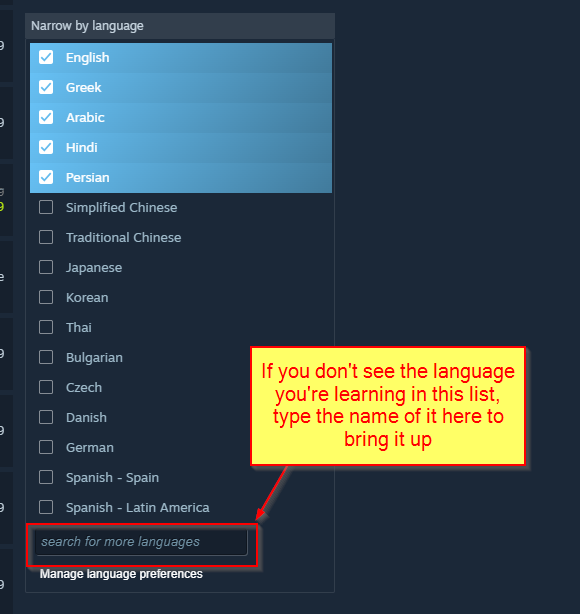
Uncheck the box for English. You don’t need that one anymore. Now check the box for Spanish (or whatever language you’re learning. Unless that language happens to be Pashto. Those games don’t exist, apparently. I’m not bitter about this at all.)
The page will show updated search results. Scroll up to the panel called “Narrow by number of players.” Check the box that says “Online Co-op”:
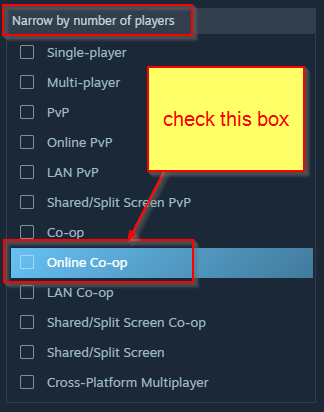
These are games you could play with your partner, but not all are ideal for language learning. For example, a racing or fighting game might not have much text to read. Let’s narrow the search even further. Scroll up to the panel that says “Narrow by tag”:
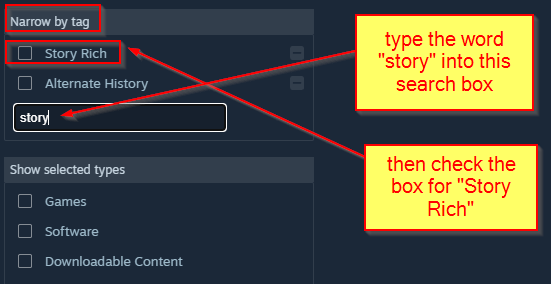
These games should have plenty of character dialogue. Notice that your search results have narrowed down dramatically:
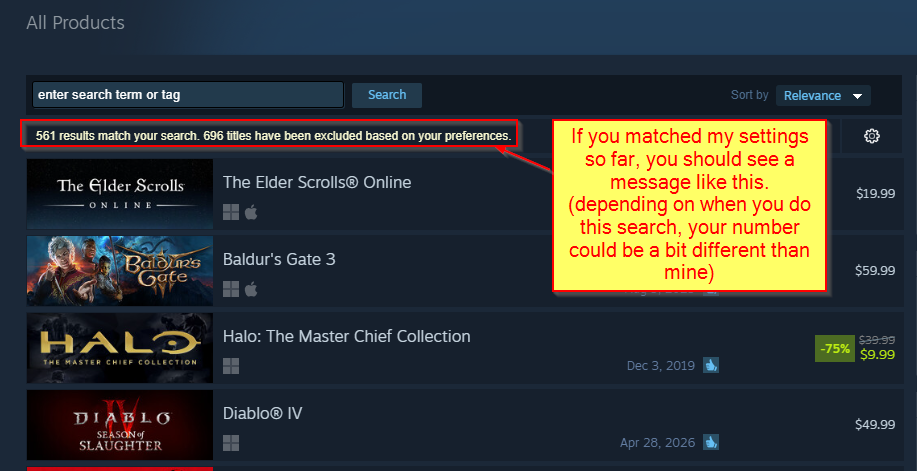
Ironically, sometimes this “story rich” tag filters out games with heavy dialogue and text. Turn this tag on and off as needed.
You’ll need to dig through the results for something that seems fun and has plenty of text. I recommend puzzle games that make you and your partner work together. Here’s the one I’ve enjoyed the most:
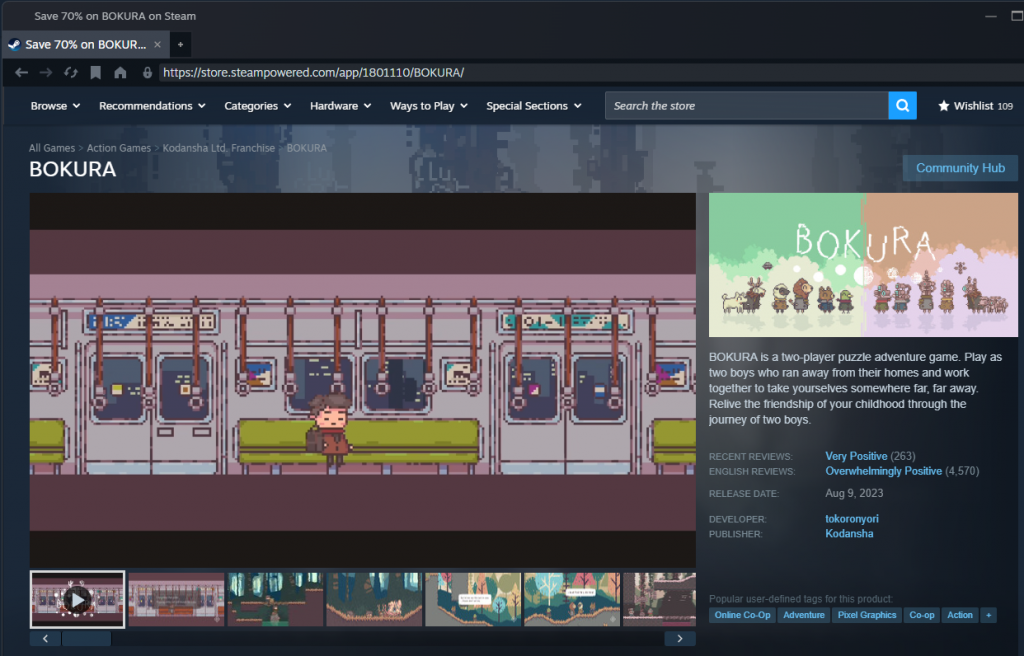
Bokura is perfect for language exchange calls for many reasons:
-It has lots of interesting dialogue
-It supports 29 languages
-The dialogue waits for you to click a button to advance it. (You can take as long as you need to read or translate it)
-The game is easy to learn how to play
-It’s really cute and fairly clean in terms of content, though there are some dark themes.
-It’s really cheap. The normal price is only $5.49 but it’s often on sale for around $1.64. Both you and your partner need to buy a copy. Steam even lets you gift a game to another user. Your partner will need to create a Steam account.
-Most importantly, you must coordinate with your partner to solve puzzles
I’m always telling my partners to “push that box onto the switch” and “stand here while I go open the door for you” and “climb that chain”–all in Arabic. Sometimes my partner and I take separate paths through an area, and I have to describe symbols above a door so my partner can press the corresponding buttons: “This symbol looks like a rabbit with no eyes.” I find myself saying some funny things in Arabic to move forward in the game, and my partners and I have laughed our heads off at the ridiculous character dialogue. We’ve lost track of time, sinking 3+ hours on some calls because we were having so much fun.
And that’s the point. If you play with your new language, you’ll invest the hours needed to become fluent. Don’t get me wrong, this is still hard. I’ve had to stop and look up Arabic words in Google Translate, then confirm them with my partner during our gameplay. After playing Bokura, there’s a long list of Arabic words I’ll never forget because of the memories I’ve tied to them. Along with useful phrases like “wait here”, “it’s this way”, “we did it!”, “let me think”, and “that was wrong.”
The sequel, Bokura Planet, is just as good. I’ve also enjoyed games from the We Were Here series. Each new game trains me to say different words and phrases, which help in “normal conversations” outside of the games.
Unsupported Languages
But Dylan, what if the game my partner and I want to play isn’t in [some obscure language]. What if I can’t find any game in that language? No problemo. If you look at the Bokura product page, you’ll see it doesn’t support Arabic. You might wonder how I use it on my calls. Here’s the workaround: Just use English.
Wait, isn’t that cheating? Well, no. Your partner needs the English dialogue. When you play a game on his day for English, just read all the dialogue exactly as written. Easy. But on your day, try to translate all the English text into your target language. Because your partner sees the same text, he can help you. And, like I do, try guiding your partner using your target language. No in-game language support is required for that.
More Than Just Calls
Video games aren’t just for calls. They also give you some of the very best language training when you’re alone.
If you pick a game with lots of text, it’ll force you to read and understand Spanish. Otherwise, you won’t make much progress in the game. You’ll learn gobs of new words this way, and learn them in their proper context. You’ll intuit grammar from reading thousands and thousands of real sentences, not artificial ones in textbooks, all while playing. It’ll be a lot of work at the start, when you have to look up most of the words. But stick with it, and you the number of words you have to look up will gradually dwindle to only the rarest words.
Doing this for the past 2 years, I’ve learned a few thousand words in Arabic, German, and Russian, and a few hundred in Greek, Swahili, and Hindi. Because this is so much fun, I can easily keep this up for the long term. It’s not drudgery I have to psych myself up for. This is what I do to relax, when I’m exhausted from writing about Scribes and moles. Language immersion is my playtime. It can be yours, too.
Some swear by watching shows and movies in their target language, and I do plenty of that, too. But I’ve learned much more from video games. They’re more interactive and require me to understand the content before I can progress. With a tv show, all I have to do is press play and let it run. Shows are passive, but games are active.
With language learning, active wins every time.
So just find the settings option in your favorite game and change it to Spanish (or whatever language). Are you binging shows on Netflix? Turn that audio setting to Spanish. Are you reading Facebook posts? Translate your webpage into Spanish. Here’s my motto:
“If I can’t consume this media in one of my target languages, I must consume something else.”
Follow that rule, and your vocabulary will grow. Armed with those new words and phrases, you’ll naturally start using them on your language calls. Your partners will notice your rapid progress and wonder what your secret is. Feel free to share this article with them. They could use the English reading practice, anyhow.
I think that’ll do it for language learning articles for a while. Next month, we’ll return to our normal science content. Don’t worry, it’ll be in English. (But you can always translate it into your new language for an extra challenge.)
Writing update: I’m done with the first draft of Emolecipation episode 2 and am working on the second draft while outlining episode 3.
Dylan West