
Power Made vs Power Used
Near the end of Scribes Emerge, Mallory says, “I think the power plant uses a pumped storage reservoir for extra output during peak demand.” She’s not talking about some futuristic tech in her world, but a well established one in ours. Let’s look a closer look.
Some power plants are load-following, meaning they try to produce just enough power to supply electrical demand, which fluctuates throughout the day. But cycling power up and down wears out components faster and produces power inefficiently. These plants are more expensive to run and normally burn natural gas.
Power plants are most efficient when they run at a constant power level. Baseload plants like nuclear ones generally run at full power all the time, sometimes making more electricity than the public needs. This raises AC frequency, which can damage equipment and cause outages.
In addition, solar and wind energy adds even more power to the grid on days with extra sunlight and wind–often more than we can use at the time.
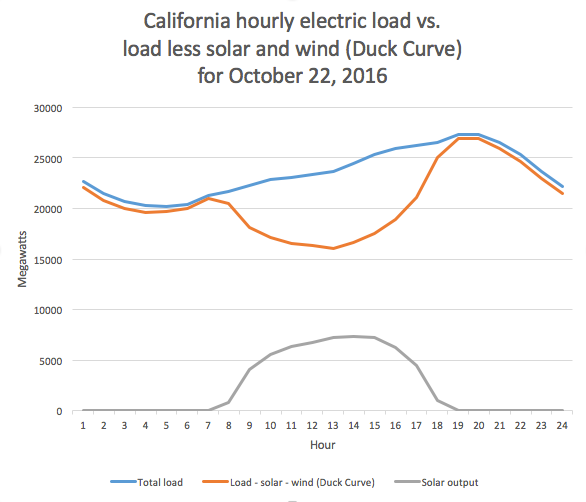
-ArnoldReinhold, CC BY-SA 4.0, via Wikimedia Commons
The blue line shows how demand (or load) rises throughout the day, peaking at around 8 pm, then drops off when people are winding down. Well, normal people. Night owls like me are getting their second wind. The gray line shows solar power made during daylight hours. The orange line subtracts the gray line from the blue, revealing how much electricity plants must make to meet the remaining need. Because of its shape, it’s call the “duck curve”.
See how complicated this gets? Power plants generally make more power than the low points in the curve and sometimes less than the high points. If only we could store the surplus power for later use.
Turns out, we do this all the time using pumped storage hydropower (PSH). During slow times, a plant can pump water from a low reservoir to a higher one. When demand increases, operators open a dam to let water fall back down. This turns a hydroelectric turbine that generates enough power to meet the higher demand, especially helpful during outages.

-In this design, the same devices serve as both pumps and turbines. Some facilities use separate machines for those functions.
A giant water battery sounds great, right? Well, there are some challenges…
Infrastructure (aka, the pesky details)
You need a special site for this. The two reservoirs need a height difference of at least 100 meters to make the system efficient. And the reservoirs need to be close together to minimize friction and turbulence losses. Finding terrain with this combination of closeness and height difference can be hard.

-Pumped Hydroelectric Storage Facility in Ludington Michigan
And each reservoir must hold a lot of water. The more volume, the more power you can store. These don’t always have to be ponds. Some sites use an abandoned mine as their lower reservoir. A few even drain into the ocean.
However, most places use freshwater from rivers. To minimize environmental impact, new sites are beginning to use closed loop systems: they reuse the same water over and over again with no connection to a natural source. However, some water is lost to evaporation and ground seepage. In some areas, rainwater is enough to replenish those losses. In drier climates, we have to refill the reservoirs from outside sources, though the needed amount is usually low. To minimize losses, some places cover their water with evaporation suppressors–plastic balls floating on the surface to shield from wind and trap in moisture. Find photos of them here: https://www.awtti.com/evaporation-control-floating-cover/
And then there’s efficiency. You don’t get back all the energy you spent to pump the water upward. However, pumped storage is more efficient than most alternatives: 70% to 93%, depending on the design and layout of the site.)
Chemical batteries are more efficient, so why not use them instead? Some places do just that because they lack suitable terrain for pumped storage. They use a giant lithium ion battery in a system called BESS (Battery Energy Storage System), but this has its own problems. Let’s compare it with Pumped Storage (PSH):
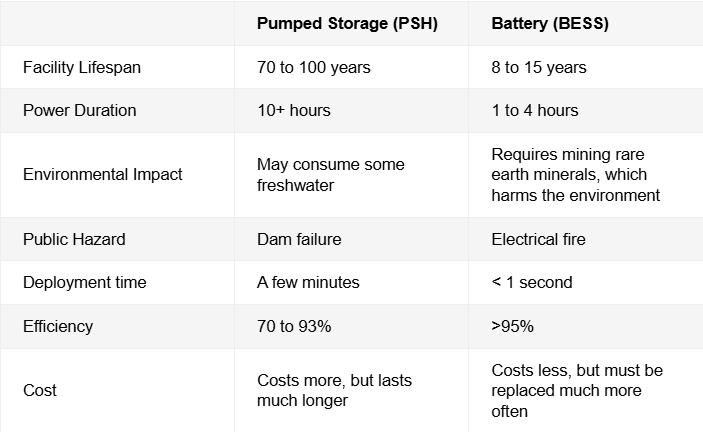
Neither method is inherently better than the other. We need both types on the grid.
Math
How much power can pumped storage provide? The potential energy formula is one way to calculate it:
Potential Energy = mass * gravity * height difference
Let’s plug in some real numbers based on the Dlouhé Stráně pumped storage facility in the Czech Republic:
Potential Energy = 2,580,000,000kg of water * 9.81m/sec^2 * 510m
= 3.4 Gigawatt hours (enough to fully charge over 56,000 electric vehicles)
How do we derive the mass of the water? While the upper reservoir has a total volume of 2,720,000 cubic meters, only 2,580,000 cubic meters is “effective”, which refers to the water that’s actually drained down through the turbines–some pockets of water will remain because they lie below the drain outlet.
Now 1 cubic meter of water weighs 1000kg. So 2,580,000 cubic meters weighs 2,580,000,000kg. This volume comes from a reservoir that is about 710m x 240m with a max depth of 26m. That’s a lot of water.
The top reservoir Mallory finds in Scribes Emerge would be about the same size. This detail matters in the story. I won’t spoil it here–read the book to see what I mean. 
Questions? Let me know. As usual, I skipped a lot of details to keep this short.
References:
–https://mb-drive-services.com/how-much-energy-is-stored-in-a-pumped-storage-power-plant/
–https://en.wikipedia.org/wiki/Dlouh%C3%A9_str%C3%A1n%C4%9B#:….
–https://en.wikipedia.org/wiki/Pumped-storage_hydroelectricit…
–https://en.wikipedia.org/wiki/Battery_energy_storage_system
Writing update: I’m almost done with the first draft of Emolecipation chapter 2. I’ve spent several weeks researching rainforests to get the details in this book as realistic as possible.
 |