
Fellow Science Lovers,
Game update: Now that I’ve passed my IT recertification exam, I’m designing more of Scribes’ Descent, the game. And to play Hollow Knight Silksong that just released. I take design notes while I play, so it’s not all goofing around. 😀 I’m testing out some new game mechanics, and I’ll get back to you on how that works out.
Depth Control
In chapter 11 of Scribes Emerge, Boxer speculates about an upcoming monster:
“A creature living in shallow water would have a swim bladder, which might make its corpse float to the surface. But this magma is high pressure. Like deep-sea fish, it shouldn’t have a swim bladder since its body couldn’t withstand the severe differential pressure.”
What’s he talking about? Let’s science our way into this.
First, a swim bladder is a sack of air found in many kinds of fish. To dive deeper, they expel air from it, and to rise, they fill it with more air. More air in the bladder = more buoyancy. That makes sense, but…
Where does a fish get air to fill its bladder when it’s deep? From its own blood, of all places. The swim bladder uses a gland to turn blood into acid, which lets gas come out of solution. More on that later.
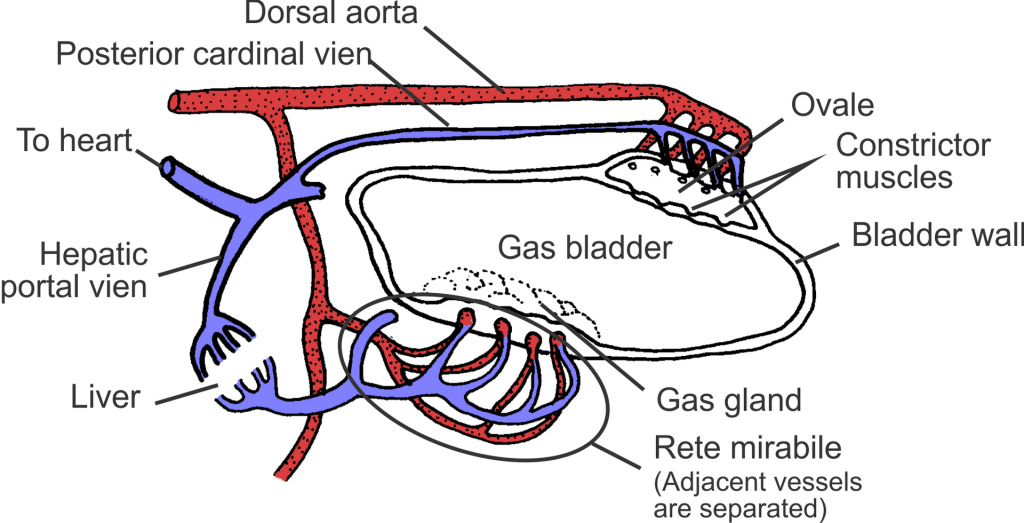
-By Jon Houseman. CC BY-SA 3.0 via Wikimedia Commons
Wait a second. That gas was already inside the fish. How can it make the fish more buoyant if the body contains the same amount of gas as before? The answer lies in density. Though the gas’s mass didn’t change, its volume did. When dissolved oxygen moves from the blood to the swim bladder, it expands, making it less dense. And when an object is less dense than water, it floats.
Human divers mimic this with a buoyancy compensator or buoyancy control device (BCD). Here is one example, and it works on the same principles as a swim bladder:
 |
Differential Pressure
That explains depth control, but what does Boxer mean about differential pressure? At any depth, the pressure outside a fish will be higher than the pressure in the swim bladder. That’s because the column of water above the fish presses down on it, compressing the water around it. The deeper the fish goes, the higher the pressure, because there’s more water bearing down from above. That compression can smash the swim bladder in on itself.
To counteract that, the fish packs its swim bladder with high pressure gas (usually oxygen) to match the outside pressure. Eels do this quite well, letting them dive to crazy depths. I imagine male eels brag about this to impress female eels. I mean, they sure can’t rely on their looks.
Anyhow, all this deep diving comes with some danger. If a fish dives too low, it can’t raise its internal pressure high enough, making the bladder collapse. When that happens, it loses buoyancy and plunges into an uncontrollable dive. Yes, that can prove fatal. I’ll let you google all the reasons why.
And to keep enzymes working under extreme pressures, a fish’s tissues must create high levels of TMAO (trimethylamine N-oxide) to keep enzymes from being crushed. Problem is, too much TMAO becomes toxic. By the way, when a fish dies, this TMAO breaks down into TMA, which causes the infamous dead fish smell.
Many deep sea fish don’t have a swim bladder at all. Instead, they change depth with active swimming. Some species have fatty oils that are less dense than water to grant them a bit of extra buoyancy, but they can’t control the volume of it.
Other Questions:
- How does TMAO protect enzymes at high pressures? A: by strengthening the water molecules around the enzymes. How? Read this: https://cen.acs.org/physical-chemistry/modeling/chemical-protects-fish-extreme-pressures/100/web/2022/10.
- How does oxygen come out of solution in blood? A: The gas gland excretes lactic acid into the blood, forming carbon dioxide. This changes into carbonic acid, which releases protons that bind to hemoglobin, changing its shape and releasing oxygen. The carbon dioxide also directly binds to hemoglobin, further changing its shape and releasing more oxygen. For more details, watch this: https://www.khanacademy.org/test-prep/mcat/organ-systems/hematologic-system/v/hemoglobin-moves-o2-and-co2
- How does a fish pressurize its swim bladder enough to match the extreme pressures of deep waters? A: by making a LOT of oxygen in the gas gland, and then diffusing it efficiently into the swim bladder by another organ called the rete mirabile using a method called countercurrent exchange. Watch this video for a nice visual:
That’s more than you ever wanted to know about fish buoyancy and chemistry, and yet I left out a lot of stuff: the different kinds of swim bladders, how some fish change their swim bladder over the course of their lives, how fish can suffer from decompression sickness, and how fishfinder sonar interacts with swim bladders to locate and identify fish.
Writing update: I’ve been brainstorming ideas for later episodes of Emolecipation, especially the next 3. I’ll keep you updated on when I begin drafting them.
 |