
Fellow Science Lovers,
Game update: No progress on the game this month while I prep for an IT certification renewal exam. Provided I pass it on Thursday, I plan to turn my focus to building out the next area of Scribes’ Descent.
Thermodynamics, the Toddler Musical
In chapter 10 of Scribes Emerge, Rain explains to the people of Sendia why they need to evacuate their city:
“A water crisis is stalking us, and it’s far worse than the elders think. In days, the Source will stop flowing and the hydro turbines will shut down. This leaves only geothermal plants to power the air conditioners. But those plants can’t run without extensive repairs, nor carry the load of all three caverns even if they were fully operational.
“Can you fix the plants before your lamps darken and your homes become ovens? Based on reports, I doubt it. But even if you can, you’ll have a bigger problem. ACs require a heat sink. The only thing cold enough to draw away heat exhaust is the water flowing from Sendia. While you could pump water to mitigate this, you don’t have the needed piping installed or the extra power to run such massive pumps. Without ample flow, heat transfer will stop, rendering your AC units worthless. When your houses become as hot as it is out here, how long will you survive?”
In the first part, he points out how they need electricity for their AC units. No mystery there, especially when this city swelters in an extremely hot region. But that bit about a heat sink needs more explanation. I didn’t want to bog down the story with thermodynamics theory, but we have time for that now.
Heat is like a toddler. It wants to move around. Unlike a toddler, heat is predictable. It moves from high temperature to a lower one.
But what is temperature? Atoms and electrons aren’t good at sitting still, even the ones in solid objects. Temperature is really speed–a cold object has slow particles bouncing around, and a hot object has fast ones. When you get burned, it’s like getting in an accident with millions of tiny cars. The atoms of a hot plate like to smash into the cells of my uncovered hand. These speedy atoms always hit and run, too, never bothering to stop and exchange insurance details with me.
Now for pressure. Squeeze toddlers into a tight closet, and they’ll bounce around more violently. Not that I’ve tested this, mind you. I’m just handing out visuals. Anyhow, the same thing happens when you compress a fluid–pressure and temperature go up. Let the toddlers out of the closet, though, and they’ll scatter, slowing a bit. Likewise, decompress a fluid, and both temperature and pressure go down.
With those concepts in mind, let’s look at how an air conditioner works. We turn it on, and cold air blows out of the vents. The end, right? Well, let’s add some nuance. First, an AC unit doesn’t make cold air as much as it removes hot air from a space.
But how does that work? Here’s refrigeration in 4 steps:
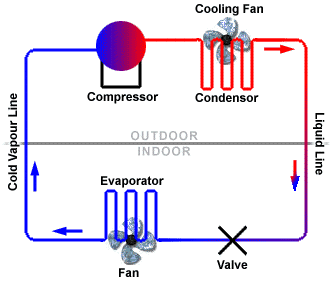
-CC BY 4.0 via ResearchGate
- A fan blows the hot air in your home across a set of evaporator coils. These coils hold refrigerant. Heat from the air transfers through the metal walls of the coils into that refrigerant, flashing it to steam. (Refrigerants boil at fairly low temperatures.)
- The refrigerant is drawn into a compressor, which squeezes those gas molecules closer together, heating them up quite a bit–much hotter than the outside air. (around 170F!) The compressor pumps the refrigerant on to the next stage.
- Another fan blows across another set of coils to transfer heat to the outside air. As this refrigerant cools off, it returns to liquid form. This happens in the condenser.
- The refrigerant flows through an expansion valve, dropping its pressure and cooling it off even more. That cool refrigerant flows back into the house, ready to remove more heat.
We call this closed loop the Refrigeration Cycle. Not a vicious cycle, but a benevolent one. Especially at this time of year. If you reverse the direction of the cycle, you get a heat pump, which heats your home in the winter.
Now that you know the basics, let’s look at the actual equipment. I’m sure you’ve seen this unit before:

-CC BY-SA 3.0 via Wikimedia Commons
It usually houses both the compressor and condenser. And here’s an air handler (mine, actually). This holds the evaporator and expansion valve:
 |
Sometimes this unit sits in a closet, sometimes in an attic. In either place, when condensation overflows the drip pan, it leaks onto the drywall of your ceiling, making an ugly water stain. If I have a nemesis, this it it.
Heat Sinks
Let’s return to what Rain said in Scribes Emerge: “ACs require a heat sink.” Remember heat flows from a hot place to a cooler place. That cooler place is called a heat sink. Normally, outside air is cool enough to act as this cooler place. Even on the hottest summer days when it can get as high as 120 degrees Fahrenheit, that’s still cooler than the 170 degree refrigerant on the hot side of the refrigeration cycle.
But the city of Sendia is surrounded by air that’s much hotter than 170F. That means heat would flow from the outside back into Sendia, making things much worse! Remember how we can reverse the cycle to heat a home? That would happen by accident here.
Rain continues, “The only thing cold enough to draw away heat exhaust is the water flowing from Sendia.” He’s referring to how their city transfers the heat removed by their AC units into the water that falls down to their city and flows through it. When that water stops, Sendia would have to pump their static water reserves away from the city, requiring massive equipment and even more electricity at a time when their power plant is already compromised. Yikes.
More Resources
Simple explanation of the refrigeration cycle:
How AC compressors work:
For all my fellow bill payers out there, ever wonder why central heat and air is so expensive? Blame it on the compressor. I’ve read that 85% of the power consumed by HVAC systems is gobbled up by this one part.
I could devote a full article to each component, because a lot of engineering goes into them. Let me know if you’re interested. Hit me up with any questions, and stay cool.
Writing update: I’ve been brainstorming ideas for later episodes of Emolecipation, especially the next 3. I’ll keep you updated on when I begin drafting them.
 |