
Word of the Year
In my church writing group, each member picks a word we hope describes the coming year. For 2026, mine is holographic.
Like a hologram, I want:
- to think in 3D, absorbing new perspectives as I move, registering depth in my surroundings because of parallax layering. To see beyond the obvious to the unvoiced nuances of mundane things, then report them back to a startled reader.
- each part of me to contain the whole. If you lop off a part of me, (like my sinuses) all my memories and qualities persist because each part of me holds the full record.
- to perform nondestructive testing on my plot ideas, using interferometry to measure flaws in my prose and story assumptions.
Okay, so science seeps into the very wording of my goals. 
The Scribes Series is full of “holograms”, and I never explained how they work and why they may not technically be holograms at all. What are these sciency-sounding things? Staple a seatbelt onto your beanbag chair and get strapped in. We’re going full geek ahead.
How It Works
Regular photographs show only one viewing angle. Tilting a photo doesn’t change the image. (Go ahead and try) Other viewing angles simply aren’t captured. But with a hologram, they are. Just how wide that range of angles is depends on the setup.
Light behaves like a wave, so here’s a reminder of how waves work.

-by CNX OpenStax. CC BY 4.0 via Wikimedia Commons
Each packet of light, called a photon, switches between bright and dim. This happens so fast we can’t perceive it. How bright the photon is at any moment is called the amplitude. How quickly it switches brightness relates to two other properties: wavelength (the horizontal distance between peaks), and frequency (how many peaks pass a given point each second).
White light has waves of various frequencies, each appearing as a different color if broken out by a prism. Wavelengths of around 400 nanometers are violet and ones around 750 nanometers are red. Men, go tell your wife the color of her eyes by wavelength. I bet nobody else has told her that before. Make sure to waggle your eyebrows when you make this little pronouncement.  Okay, back to science…
Waves also have phase. When two of them travel side by side, they’re in phase when their peaks line up. See the left side in the image below. And they’re out of phase when their peaks are offset. See the right side:

-by Quibik. CC AS 3.0 via Wikimedia Commons (part of the image removed for clarity)
For a hologram to work, the light beam that strikes an object must have waves of the same frequency and phase. That means you need a laser. Here’s what I mean:
 |
I couldn’t find an uncopyrighted diagram that I liked, so I made my own. If drawing tidy waves were a sobriety test, I’d be in the back of the police car right now. In the bottom part, pretend with me that those 3 blue waves are lined up perfectly. That’s a laser. Over 20 years ago, I paid someone $3,100 to shoot one of those in my eyes. Best money I ever spent.
Now here’s the setup for a simple hologram. You get lots of pictures this month:

-by DrBob. CC BY-AS 3.0 via Wikimedia Commons
We send a laser beam into a splitter to break it into 2 new beams. Each one has the same frequency and are in the same phase. We send each through an expanding lens–not shown in the diagram–to spread the beam across a wider area. One beam strikes the object (the object beam) and gets reflected onto the photographic plate where the hologram is recorded. Think of this plate as film. The other beam reflects off of a mirror and goes to that same plate, bypassing the object entirely. (the reference beam)
These two sets of light waves hitting the plate interfere with each other, causing wild patterns. Let’s look at a fuller version of the prior wave diagram:
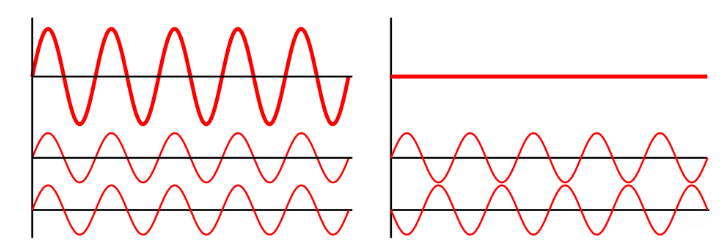
-by Quibik. CC AS 3.0 via Wikimedia Commons (full image this time)
On the left, two small waves that are in-phase with each other collide to make a new wave that’s double the original size. (constructive interference) On the right, two small waves in opposite phases will cancel each other out (destructive interference). This is how sound-canceling headphones work, by the way. Between the values of 0 and double lay a range of possible brightness values. And this example only considers 2 waves. The resulting patterns get complex when a whole field of light beams collide:

-by Epzcaw. CC BY-SA 4.0 via Wikimedia Commons
Those are holographic interference patterns for two small toys. Can’t you tell? If you pass the reference laser through the back of the plate containing these patterns, you’ll see the original objects in full 3D, even when the toys are no longer there. The Grinch stole Christmas, I suppose. The plate now looks like a window into a room, like you could climb in and rummage around. Not that I ever tried this, or anything. Okay, I did, but I bumped into the plate every time.
So a hologram captures not only the amplitude of light waves striking the object (regular photos do this) but also the phase of the waves (regular photos can’t do this). But how does an interference pattern recreate a full 3D scene? To understand, you need to see animations, so watch this video for the completest explanation I’ve ever found:
While I recommend all 46 minutes of it, the most relevant part is from 12 minutes to 35 minutes. Fair warning, this is complicated, mathy stuff. I had to watch it twice.
Still confused or noped out of the video? How about this: when the reference and object lasers collide on the plate, their light waves are no longer in the same phase. That’s because the object beam had to bounce off of an object along the way. Every little bump and groove on the object’s surface tweaks the bounced light just a smidge. Those slight differences reveal what the object looks like.
Not Real Holograms
With that understanding in our noggins, let’s look at why projections in the Scribeverse may not be real holograms. Remember that holovisors project light to create 3D images in midair, like the Princess Leia hologram in Star Wars. That’s quite different from holograms as we know them today, which are stored on a flat plate, not in a point cloud in the air your hand can pass through.
This free-floating 3D projection is called a volumetric image. It can be made in different ways, each of which could fill its own article, but I think visors in my series would use something like plasma displays. Here’s a quick description:
-high-powered lasers excite electrons in the air molecules or water vapor, making tiny orbs of plasma. I covered electron excitation in a prior newsletter.
-When electrons fall back to their normal energy values, they emit photons, making flashes of visible light
-The projector shoots enough of these lasers to create a full 3D scene based on a model file. This could be like the ones artists create in programs like Blender and Maya, or they could pull data from holographic interference patterns. (which would make the holovisor truly holographic)
We’ve already made a laser-induced plasma display, though it’s still low-res:
I think the flickering in this video wouldn’t be as bad when viewing it in real life. Cameras can do funny things to animations because of their shutter speed.
But the plasma display has challenges: how do you avoid burning cats and toddlers with your projected lasers? I’m guessing you can’t, hence the clear case surrounding the lasers. And this kind of projection wouldn’t work in outer space where there are little-to-no molecules to ionize.
I don’t know how the Facility researchers solved these problems in the Scribeverse, but their entire tech base is at least 400 years beyond ours. *Dylan presses his big ‘ole I believe button*
Okay, I probably ionized your brains with all this technical stuff, and yet I glossed over a lot of details. There’s just no way to pack everything into one article. You’re bound to have questions, so please reply and let me know.
I hope you enjoyed Christmas. The Grinch tried to steal my presents, but I caught him and sold him a paperback of Scribes’ Descent. He’s still reading it in my bedroom, so if he didn’t steal your Christmas, it’s my fault for distracting him.
And have a Happy New Year filled with God’s favor and presence. He’s right here, and that’s all that matters.
Writing update: I’m almost halfway through the first draft of Emolecipation chapter 2. More moleish humor is heading your way!
 |