
Depth Control
In chapter 8 of Scribes Emerge, Mallory sees elemental sulfur scattered across a volcanic area and has this thought:
Sulfur. Enough for the Sendians to vulcanize all their rubber tires.
The book never explains what vulcanization is, so we’ll look at this right now.
Let’s start with natural rubber, which comes from latex:

-By Vyacheslav Argenberg. CC-BY-4.0 via Wikimedia Commons
Though the city of Sendia wouldn’t have latex trees, they could synthesize latex from petroleum, which they did have. Both kinds are made of long chains of isoprene molecules, called polyisoprene:

-By Smokefoot. CC BY-SA 3.0 via Wikimedia Commons
Each isoprene molecule kinda looks like a rocking chair.
Untreated rubber has these long chains laid in parallel with no bonds to connect them at the sides. That lets the chains slide freely past each other, making the rubber weak and vulnerable to plastic deformation–when you stretch it too far, it won’t return to its original length. Stretch it farther, and it’ll break. Like when you overload your plastic grocery bags to the point of ripping. You bag stuffers know who you are.
Stronger and Stretchier
Add molecules between the polyisoprene chains and the rubber becomes much stronger. That’s vulcanizing. In 1839 (in our universe), someone spilled a mix of sulfur and rubber onto a hot stove and noticed the improvement. He spent a decade and $50,000 perfecting this chemical reaction. That’s worth over $1.2 million today. In the end, he died with over $200,000 of debt ($7.8 million in today’s dollars). He never enjoyed financial success for his history-changing invention. Most only remember his name because of the tire company someone else named in his honor. His name was Charles Goodyear.
Sad story aside, why does sulfur help? It fits well between the isoprene chains:
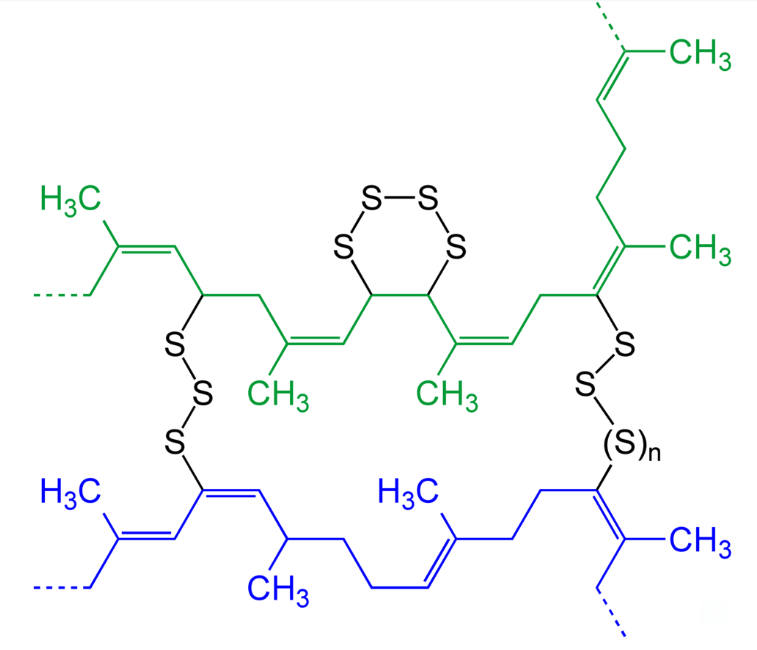
-The Wikipedia article for this image has a note saying some contributors question this diagram’s accuracy. Even if imperfect, it gives the idea of how cross linking works.
You can’t just mix sulfur with latex to get this effect. You have to get the quantities just right and heat it to a certain temperature for the right duration. Early attempts took 6 hours, but nowadays we can do it in under a half hour with accelerators–chemical additives that speed up the chemical reaction. You may be tempted to call them catalysts, but that’s not quite right. A catalyst isn’t consumed during the reaction. These accelerators are.
Vulcanization isn’t an on-or-off switch. Depending on how you tweak the parameters of time/temperature/pressure/additives, you can add more and longer crosslinks to control the final properties:
- More crosslinks raises hardness (and brittleness).
- Shorter crosslinks makes the rubber more resistant to heat and weathering.
- Longer crosslinks improves durability and tensile strength.
But it’s not all positive. Vulcanization also makes rubber harder to shape and recycle, and poses an environmental hazard. It takes up space in landfills and can’t be burned without releasing toxic gases. Even the manufacturing process can cause air and water pollution.
As usual, I’m omitting lots of details here: why is sulfur used instead of other elements for crosslinks? Are there alternatives to latex trees for natural rubber? What big threats are there to the world supply of latex trees? I can answer these in a future newsletter if enough people are interested.
Watch this awesome video for a fuller explanation of what I covered here:
Questions or comments? Let me know.
 |